
Loading...
Serving Conway, AR and surrounding areas. (501) 497-0067
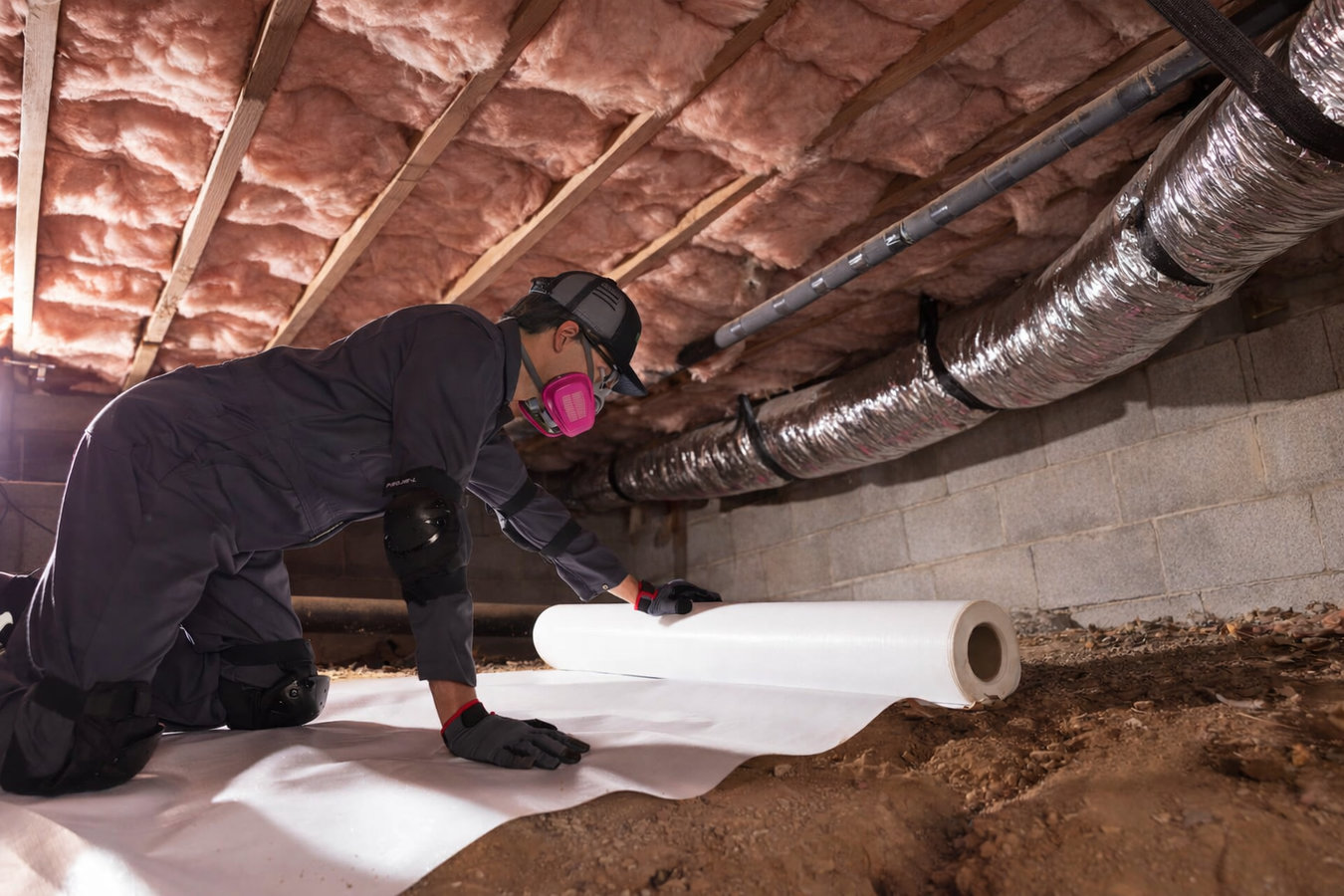
Ground moisture under your home attacks your floors, drives up your cooling costs, and attracts termites all year long. Proper vapor barrier installation cuts off that moisture at the source so your home stays dry and your floor system holds up.
Vapor barrier installation in Conway, AR means fitting thick plastic sheeting over the bare ground in your crawl space or basement to block ground moisture from rising into your home - most installations are completed in one to two days with no disruption to your routine. The material acts as a physical seal between the damp earth and the wood framing, insulation, and air that make up your floor system. Think of it as a raincoat for the underside of your house. Without it, ground moisture in Conway's humid climate moves upward continuously - not just when it rains. For homes built before 1990, there is a real chance the original liner has degraded past the point of being useful.
Vapor barrier work is often the first step before any other under-home improvement. If you are planning retrofit insulation or other floor system upgrades, getting the moisture sealed off first means any insulation you add will perform as designed - not gradually absorb the ground moisture it was installed over. The two projects pair naturally, and doing them together saves time and reduces overall cost.
The U.S. Environmental Protection Agency mold and moisture guidance identifies unprotected crawl spaces as one of the leading sources of indoor moisture problems and musty odors in residential homes - conditions that are especially persistent in climates like central Arkansas where the ground stays warm and moist for most of the year.
A persistent musty or earthy smell inside your home - particularly noticeable first thing in the morning or after a heavy Arkansas rainstorm - is often a sign that moisture is moving up from an unprotected crawl space. That smell is an early warning of mold or mildew growing in places you cannot see. If opening windows does not make it go away, the source is almost certainly below your floors.
If you notice areas of your floor that give a little when you walk on them, or spots that feel different from the rest, moisture damage to the wood underneath may already be underway. In Conway's humid climate, crawl spaces without proper moisture protection are a leading cause of this kind of floor damage. Having someone look underneath sooner is far cheaper than replacing structural wood later.
Many Conway homes built before the 1990s were constructed with little or no moisture protection under the house. If you have lived in your home for years without anyone looking at the crawl space, there is a reasonable chance whatever was originally installed - if anything - has degraded. This is especially common in older Conway neighborhoods closer to the Arkansas River lowlands.
Pest control professionals in the Conway area routinely inspect under homes and frequently flag moisture problems before homeowners are aware of them. Faulkner County is in a high-risk zone for subterranean termites, which are strongly drawn to damp wood. If a termite inspector or pest tech has mentioned moisture or conditions that attract insects, that is a direct signal your crawl space needs attention.
Conway Insulation installs vapor barriers across crawl spaces and below-grade areas throughout Conway and Faulkner County. For standard crawl spaces, we lay durable polyethylene sheeting over the full ground surface - fitted around piers and obstacles, overlapped at seams by at least a foot, and fastened to the foundation walls so nothing shifts or peels over time. We work alongside our crawl space vapor barrier service to provide the right solution for each home's specific layout and moisture conditions. For homes with more persistent moisture problems, we offer full encapsulation with foundation wall coverage and optional dehumidifier installation.
Every job starts with a physical inspection before any material is quoted or purchased. We check the crawl space condition, measure the space, note any obstacles, and confirm whether old liner needs to come out first. You receive a written estimate after the visit - not a vague range over the phone. We use materials rated 10 mils or heavier on every installation because thin liners degrade quickly in central Arkansas's climate and end up costing homeowners more in the long run through repeat work. No shortcuts on material and no skipping the seams.
Best for homes with a straightforward, accessible crawl space that needs a new or replacement liner to stop ground moisture from rising.
For homes where a degraded, brittle, or torn existing liner needs to be pulled out and replaced with a properly installed barrier.
Suited for homes with a history of moisture problems, standing water, or clay soils that stay saturated after Conway's spring rain season.
For homes where passive moisture blocking is not enough and active humidity management is needed to protect the floor system year-round.
Conway's climate stays warm and humid for most of the year, which means the ground under your home is almost always pushing moisture upward - not just in the rainy seasons. The clay-heavy soils throughout Faulkner County drain slowly and hold water near the surface for extended periods after rain, giving ground moisture more opportunity to work its way into unprotected crawl spaces. For homeowners in older Conway neighborhoods near downtown or near the UCA campus - where homes from the 1950s and 1960s are common - a functional vapor barrier may never have been installed in the first place. Homeowners in Cabot and surrounding Faulkner County communities face the same soil conditions and see the same long-term structural effects from unprotected crawl spaces.
Faulkner County falls within a high-termite-pressure zone, and pest control professionals throughout the area consistently identify unprotected, damp crawl spaces as the primary draw for subterranean termite activity. Vapor barrier installation is not a termite treatment, but it removes the moisture condition that makes your home attractive to them - a practical first line of defense that pest control companies in the area routinely recommend. Homeowners in Searcy and the broader central Arkansas region deal with the same termite pressure and moisture challenges. The Insulation Contractors Association of America recommends moisture control as a foundation step before any other crawl space or insulation work in humid climates.
Call or submit the form and we will get back to you within one business day. We will ask about your home's age, whether you have noticed any moisture signs, and whether anyone has been in the crawl space recently. No technical knowledge needed - just describe what you have observed.
We physically inspect the crawl space before quoting a price - checking its size, current condition, ease of access, and whether any prep work is needed first. The inspection takes 30 to 60 minutes and is free with no obligation. You get a written estimate that explains what will be done and why, in plain language.
The crew works entirely under the house. Old material comes out first, then the new barrier is cut, fitted, overlapped, taped, and fastened to the foundation walls. You do not need to be home, though many homeowners prefer to be available for a quick question if anything unexpected comes up.
When the job is done, we walk you through the results - with photos from inside the crawl space showing the finished installation. We explain what to watch for in the coming weeks and answer any questions. All removed material is hauled away. Within a few weeks, most homeowners notice the musty smell fading.
We respond within 1 business day. The inspection is free, the written estimate carries no obligation, and the crew works under the house - not inside it. Call or submit the form to get started.
(501) 497-0067We photograph each job before and after, so you have a clear record of exactly what was found and what was completed on your property - a level of documentation we bring to every project.
We do not quote vapor barrier work over the phone without seeing your crawl space. Every estimate is based on a physical inspection and delivered in writing, with a clear explanation of what is included and why. No vague ranges, no surprise additions when the crew shows up.
We work in Conway and the surrounding area regularly and know the common crawl space conditions in this part of Arkansas - the clay soils, the older housing stock near downtown, and the spring moisture patterns that affect homes built near lower terrain. That local knowledge leads to better assessments and more lasting work.
Hidden work needs documentation. We photograph your crawl space before installation and after, so you have a clear record of what was found and what was done. That documentation stays with you - useful for home sales, insurance records, or simply knowing the work was completed correctly.
Vapor barrier installation is straightforward work done right or done wrong - the difference shows up years later in your floors and framing. Contact us to schedule a free inspection and get a written estimate with no pressure to decide on the day.
After the vapor barrier is sealed, add insulation to the crawl space walls or floor joists for a complete thermal and moisture solution.
Learn moreFocused crawl space ground cover installation for homes that need a dedicated barrier solution specifically for the area under the house.
Learn moreSpring and summer are the hardest months on an unprotected crawl space. Call now or submit a request - the inspection is free and the sooner moisture is sealed off, the less damage builds up over time.