
Loading...
Serving Conway, AR and surrounding areas. (501) 497-0067
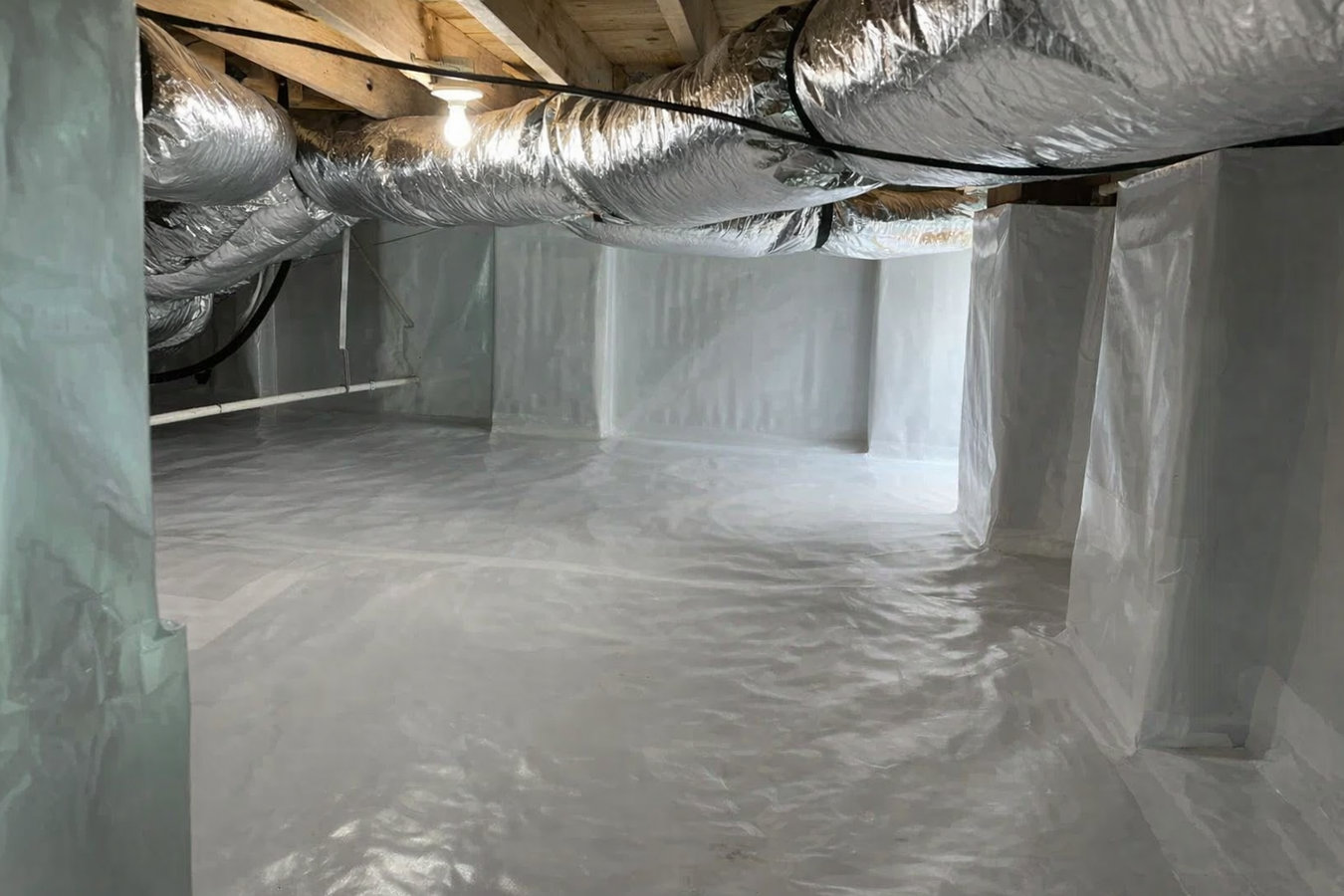
Bare dirt under your home sends moisture into your floors, insulation, and wood framing every single day. A proper vapor barrier seals off that moisture so your home stays dry, solid, and energy efficient.
Crawl space vapor barrier installation in Conway, AR means laying heavy-duty plastic sheeting across the bare dirt floor under your home to block ground moisture from rising into your floor system - most single-family homes take one to two days to complete. The barrier cuts off the moisture at its source before it can reach your floor joists, insulation, and subfloor wood. Without one, that ground moisture moves upward every single day, not just during rainy weather. In Conway's humid subtropical climate, the crawl space floor is almost always releasing moisture - a vapor barrier is the most direct way to stop it.
Many Conway homes built in the 1970s and 1980s either have no barrier at all or have a thin, brittle liner that has been degrading for decades. If you have noticed a musty smell drifting up through your floors or soft spots developing underfoot, the crawl space is almost always the source. Vapor barrier work pairs well with crawl space insulation for a complete moisture and energy solution under your home.
The U.S. Department of Energy moisture control guidance identifies crawl space moisture as a primary driver of indoor air quality problems, elevated cooling costs, and structural wood damage in homes with vented crawl spaces - all conditions common in central Arkansas.
That damp, earthy odor drifting into your living room or hallway is one of the clearest signs that moisture is rising from your crawl space. In Conway's humid climate, this smell tends to be strongest in late spring and summer when ground moisture is at its peak. If you notice it more after rain or on humid days, your crawl space is almost certainly the source.
When floor joists absorb moisture over time, they begin to soften and sag. If you notice a bounce or give in your floors - especially near the center of a room - the wood underneath has been taking on moisture for a while. This is a more advanced warning sign, meaning the problem has likely been building for more than one season without a barrier in place.
If you peek into your crawl space access hatch and see exposed soil - or a thin, crinkled plastic sheet pulling away from the walls - you have little to no effective moisture protection. Many Conway homes built in the 1970s and 1980s were never fitted with a proper liner, or had one installed that has long since deteriorated past the point of doing any good.
Conway summers are long and hot, and your HVAC system already works hard. If your cooling costs seem higher than your neighbors' or higher than they used to be, excess crawl space moisture can be part of the reason - it raises the humidity load your air conditioner has to fight. A vapor barrier reduces that moisture load and can take real pressure off your system.
Conway Insulation installs vapor barriers in two primary configurations depending on what your crawl space needs. A standard ground cover installation lays heavy-duty polyethylene sheeting across the entire dirt floor, with seams overlapped and taped and edges fastened to the foundation walls. For homes that need more complete moisture management - particularly older Conway homes on clay soil or those that have had standing water - we offer full crawl space encapsulation that covers both the floor and the foundation walls and can include a dehumidifier. We also pair barrier work with vapor barrier installation services for properties that need broader coverage across multiple areas of the structure.
The thickness of the material matters in central Arkansas. We use liners rated at 10 mils or heavier on every job because thin plastic degrades quickly in a crawl space that sees foot traffic, pest activity, or high year-round humidity. A liner that tears within five years is not a solution - it is a repeat cost. Before we quote a price, we inspect the crawl space, check the current condition, and confirm whether there is old material or standing water to address. That visit is free and there is no obligation to proceed.
Best for homes with a dry, accessible crawl space that has never had a barrier or has an old liner that needs replacing.
Suited for homes with a history of standing water, strong musty odors, or clay soil that stays saturated after Conway's spring rains.
For homes where ground moisture is heavy year-round and a passive barrier alone cannot keep humidity at a safe level.
For older Conway homes where a degraded barrier needs to come out before a new one can be installed correctly.
Conway sits in central Arkansas with a humid subtropical climate that keeps humidity levels high for most of the year - not just during the wettest months. The clay-heavy soils in Faulkner County drain slowly and stay saturated for days after rain, which means the ground under your home is almost always releasing moisture upward. This is not a seasonal problem you can address once and forget. For Conway homes with unprotected crawl spaces, moisture is working against the floor system every day. Homeowners in Benton and across central Arkansas deal with the same clay soil conditions and see the same results from quality barrier work.
A large share of Conway's housing stock was built between the 1970s and 1990s - a period when crawl space moisture standards were much less strict than they are today. Many of those homes were built with no liner at all, or with a thin 4-mil sheet that has long since crumbled. Conway also sits in a high-risk zone for subterranean termites, and pest control professionals throughout Faulkner County consistently flag unprotected, damp crawl spaces as the single biggest attractant for termite activity. Homeowners in Maumelle and nearby communities face the same termite pressure and use crawl space moisture control as a first line of defense. The University of Arkansas Cooperative Extension notes that reducing moisture under and around the home is one of the most practical steps Arkansas homeowners can take against termite risk.
Call or submit the form and we will get back to you within one business day. We will ask a few basic questions about your home - its age, whether you have noticed any moisture problems, and whether anyone has been in the crawl space recently. This helps us come prepared and give you a useful estimate without unnecessary back-and-forth.
We get under your house and take a look at the current condition - checking the floor, the walls, whether there is standing water or old liner to remove, and how easy the space is to access. This inspection is free and takes about 30 to 45 minutes. You receive a written estimate before any work is agreed to, with no obligation to proceed.
The crew works entirely under the house. They remove any debris or old material, lay the new sheeting across the entire crawl space floor, overlap and seal every seam with heavy-duty tape, and fasten the edges to the foundation walls. Most single-family homes are completed in one day. You do not need to leave the house.
When the work is done, we walk you through what was installed - often with photos from inside the crawl space so you can see the finished result without going under yourself. We explain what to watch for going forward. All old materials are hauled away and the job site is left clean.
We respond within 1 business day. The crawl space inspection is free and the written estimate carries no obligation. Call or submit the form to get started.
(501) 497-0067We photograph each job before and after, so you have a clear record of exactly what was found and what was completed under your home - a level of documentation we bring to every project.
We do not install thin, bargain-grade liners. Every crawl space job uses material rated at 10 mils or heavier, which holds up under foot traffic, resists punctures, and performs in Conway's year-round humidity for years longer than lighter alternatives.
We work across Conway and Faulkner County and know exactly what older homes look like underneath - the clay soil buildup, the degraded 1980s liners, the low-clearance spaces near the river. Local experience means fewer surprises and faster, cleaner work.
We photograph the crawl space before and after every job so you have a record of what was found and what was done. You should never have to wonder whether the work under your house was completed - we give you the proof before we leave.
A crawl space vapor barrier is not glamorous work, but it protects the wood and insulation that everything above it depends on. Contact us to schedule your free inspection and get a written estimate - no sales pressure, no obligation to move forward on the day.
Broader vapor barrier coverage for homes that need moisture protection across multiple areas beyond just the crawl space floor.
Learn moreAdd insulation to your crawl space walls or floor joists after the vapor barrier is in place for a complete moisture and thermal solution.
Learn moreSpring rains and summer humidity are the hardest months on an unprotected crawl space. Call now or submit a request to get a free inspection on the schedule before the damage compounds.